 Sarra
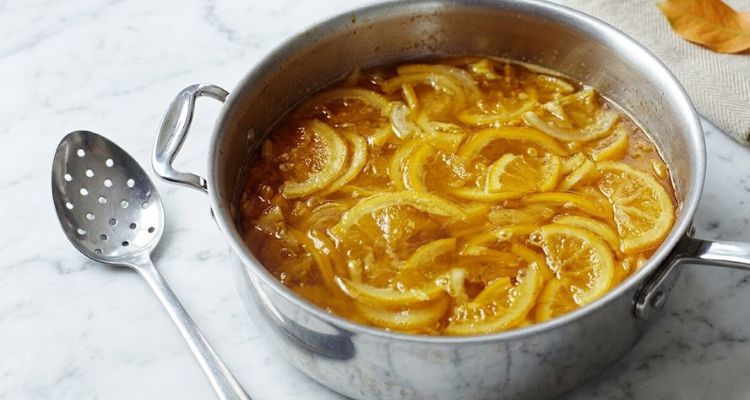
Sarra Ina Garten’s orange marmalade is a homemade preserve made with just three ingredients: seedless oranges, lemons, and sugar. The fruit gets sliced into thin half-moons, simmered with water and sugar over two days, and cooked to 220F (105C) until it sets into a golden, glossy spread. It makes 3 to 4 pints and takes about 3 hours of active cooking time spread across 2 days.
This recipe comes from Barefoot Contessa at Home, though Ina credits her friend Anna Pump’s Country Weekend Entertaining cookbook as the original source. Ina calls it “my absolute favorite orange marmalade” and says it was so popular at Anna’s Loaves & Fishes store in Sagaponack that “you have to order it in advance to be sure you can get some.” What makes it work is the balance: “it’s not too sweet and not too tart,” and it yields enough jars “to give away as hostess gifts.”
The overnight rest between day one and day two is not optional. Soaking the sliced fruit in the sugar-water solution for a full night softens the rinds, draws out the pectin, and lets the sugar fully penetrate every piece. Skip it and cook everything in one shot and the rinds stay tough and chewy while the marmalade either doesn’t set properly or ends up too thick because you had to overcook it to compensate.
Ina Garten Orange Marmalade Recipe
Course: SaucesCuisine: American, BritishDifficulty: Easy4
servings15
minutes2
hours40
minutes50
kcalAnna Pump’s legendary recipe adapted by Ina in Barefoot Contessa at Home. Only three ingredients and no special canning equipment, just clean Mason jars run through the dishwasher. The two-day process sounds involved, but most of the time is hands-off simmering and overnight resting.
Ingredients
-
4 large seedless oranges
-
2 lemons
-
8 cups (1.6kg) sugar
Directions
-
Day 1: Slice and soak. Cut the oranges and lemons in half crosswise, then into very thin half-moon slices. A mandoline makes this fast, but a sharp knife works fine. Discard any seeds. Place the sliced fruit and all their juices into a large stainless-steel pot. Add 8 cups of water and bring the mixture to a boil, stirring often. Remove from the heat and stir in the sugar until it dissolves completely. Cover and let it stand overnight at room temperature.
-
Day 2: Simmer low. Bring the mixture back to a boil. Reduce the heat to low and simmer uncovered for 2 hours, stirring occasionally. The fruit will soften and the liquid will start to thicken and turn golden.
-
Boil gently to set. Turn the heat up to medium and boil gently for another 30 minutes, stirring often so it doesn’t scorch on the bottom. Skim off any foam that forms on the surface. Cook until the marmalade reaches 220F (105C) on a candy or instant-read thermometer.
-
Test for doneness: Place a small spoonful on a plate and refrigerate it until cool but not cold. If it’s firm but spreadable, neither runny nor hard, it’s done. If it’s still runny, keep cooking. If it’s too hard, stir in a little more water.
- Jar the marmalade: Pour into clean, hot Mason jars. Wipe the rims thoroughly with a clean damp paper towel and seal with the lids. Store in the pantry for up to a year.
FAQs
Why does the fruit soak overnight in the sugar water?
The overnight soak does three things at once. It softens the orange and lemon rinds so they turn tender and translucent instead of staying tough and chewy. It draws pectin out of the citrus pith, which is what makes the marmalade set without adding any commercial pectin. And it gives the sugar time to fully penetrate the fruit slices so the flavor is even throughout.
Try to cook everything in one long session and the rinds never soften properly. You end up with hard, bitter strips of peel floating in either a runny syrup or an overcooked, dark paste. The overnight rest does the work that no amount of extra boiling can replace.
How do you know when the marmalade is done?
The thermometer reading of 220F (105C) is the most reliable test. That’s the temperature at which the sugar concentration is high enough for the pectin to set into a gel when cooled.
Ina also describes a plate test as a backup: spoon a small amount onto a cold plate, refrigerate until cool, and check the texture. If it wrinkles slightly when you push it with your finger and holds its shape without running, it’s ready. If it’s still liquid, keep cooking and test again in 5 minutes. The marmalade also continues to set after jarring, so slightly runny off the stove is better than overcooked.
Can you halve this recipe?
You can, but the cooking times change. Use 2 oranges, 1 lemon, 4 cups sugar, and 4 cups water. The overnight soak stays the same, but the day-two simmer will take less time because there’s less liquid to reduce, closer to 1 hour 30 minutes on low instead of 2 hours.
Watch the temperature carefully with a smaller batch because it reaches 220F (105C) faster once the liquid reduces. A smaller volume also scorches more easily on the bottom, so stir more frequently during the final 30-minute boil.
How long does homemade orange marmalade last?
Sealed in clean Mason jars, it stores in the pantry for up to a year. Once you open a jar, move it to the fridge where it keeps for several months.
Ina’s method isn’t a full water-bath canning process, so the jars rely on a hot-fill seal. As long as the jars were sterilized in the dishwasher and the rims were wiped clean before sealing, the hot marmalade creates enough of a vacuum seal for long pantry storage. If a jar doesn’t seal properly, just refrigerate it and use it first.
What can you use homemade orange marmalade for?
Toast is the obvious use, but Ina also uses orange marmalade as a glaze. Her Orange Marmalade-Glazed Ham in Go-To Dinners combines marmalade with brown sugar, Port, mustard, and chutney to coat a bone-in ham. Homemade marmalade works beautifully in that glaze because the thin-sliced citrus pieces melt into the sauce.
It also works stirred into yogurt, spooned over vanilla ice cream, spread inside a layer cake, or whisked into a vinaigrette with olive oil and Dijon mustard. Ina suggests making extra specifically “to give away as hostess gifts,” so jar a few extra pints in nice Mason jars with a simple label.
